Are Silicones Bad for Skin? 13 Evidence-Based Truths About Silicone Skincare Ingredients
Why Silicones Remain One of Skincare’s Most Debated Ingredients
Few skincare ingredients spark as much confusion as silicones. Patients ask if they clog pores. Estheticians question their long-term effects. Marketing often labels products as “silicone-free” without explaining why.
Yet silicones are found in nearly half of all cosmetic formulations—from serums and moisturizers to sunscreens and primers.
So what’s actually true?
In this episode of the Facially Conscious Podcast, our interdisciplinary panel—bringing together cosmetic chemistry and esthetic expertise—examines 13 of the most common myths about silicones. The goal isn’t to defend or dismiss them, but to understand them clearly.
What Are Silicones in Skincare?
Silicones are synthetic polymers made from silicon and oxygen, structured as repeating molecular units. Their size and structure give them unique properties that are difficult to replicate with other ingredients.
From a formulation perspective, silicones are valued for their ability to:
- Improve spreadability and texture
- Create even application of active ingredients
- Enhance sensory feel without heaviness
- Provide protective, breathable films on the skin
They are not naturally occurring—but their base materials (silicon and oxygen) are among the most abundant elements on Earth.
Why Silicones Are So Widely Used in Skincare Formulations
Before modern silicone use, skincare products were often inconsistent in texture and application. Silicones helped solve key formulation challenges:
- Uniform delivery of actives (like retinol, AHAs, BHAs)
- Improved sunscreen coverage for consistent UV protection
- Reduced irritation potential through even distribution
- Enhanced skin feel without occlusive heaviness
In short, silicones are functional—not just aesthetic.
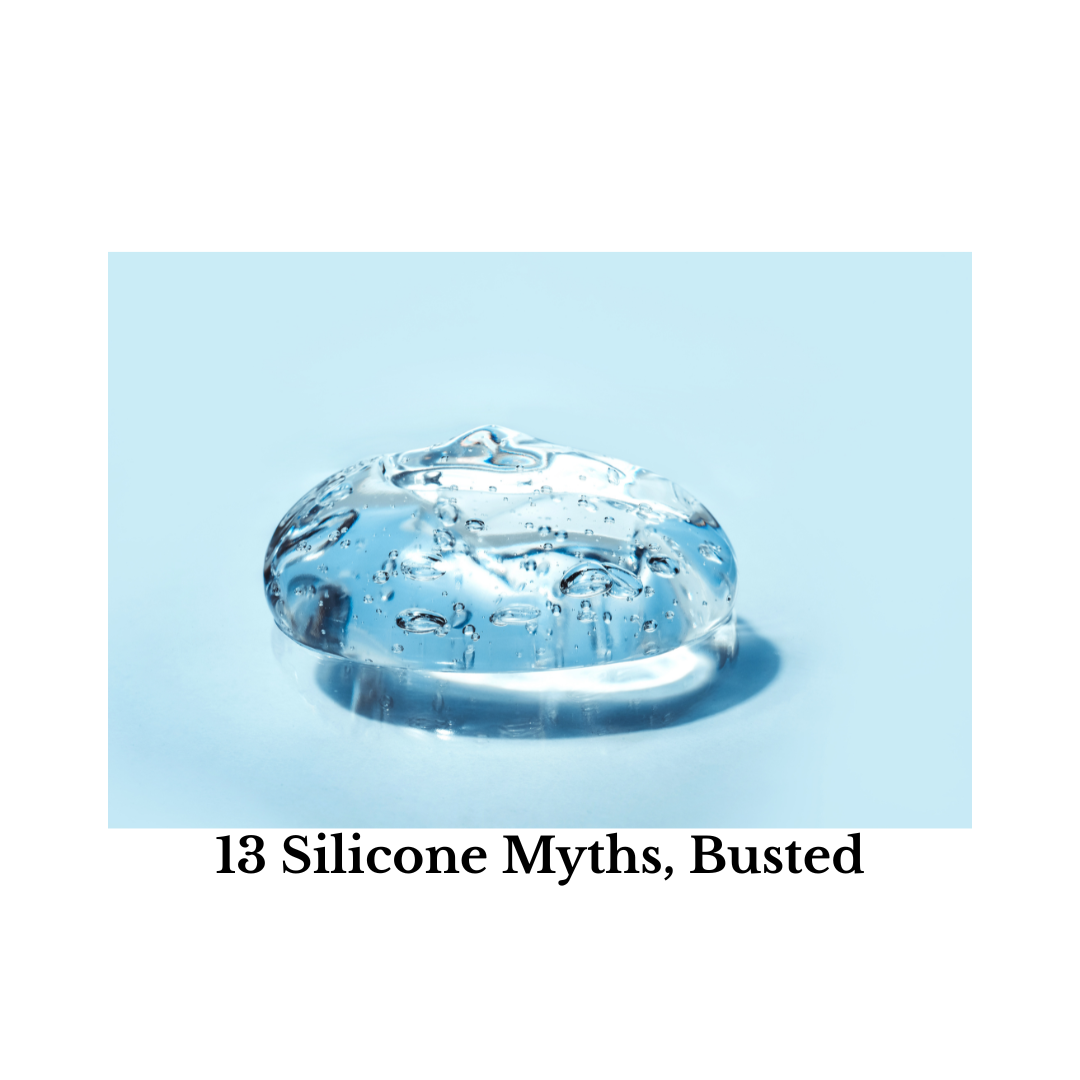
13 Silicone Myths, Busted
Myth 1: Silicones Are Just Cheap Fillers
Reality: Silicones are highly engineered ingredients that improve performance, stability, and user experience—not inexpensive fillers.
Myth 2: Silicones Are the Same as Microplastics
Reality: Silicones are not carbon-based, which distinguishes them from plastics. They do not break down into microplastics.
Myth 3: Silicones Are Difficult to Remove
Reality: Despite being water-resistant, silicones are easily removed with standard cleansers or micellar water.
Myth 4: Silicones Clog Pores and Cause Breakouts
Reality: Silicones are non-comedogenic. They do not oxidize—a key requirement for pore-clogging reactions.
Myth 5: Silicones Are Toxic
Reality: Due to their large molecular size, silicones remain on the skin’s surface and are considered biologically inert.
Myth 6: Silicones Penetrate the Skin Barrier
Reality: Their molecular structure prevents meaningful penetration, limiting systemic interaction.
Myth 7: Silicones Suffocate the Skin
Reality: Silicones form a breathable barrier, allowing oxygen exchange while protecting the skin.
Myth 8: Silicones Trap Dirt and Pollutants
Reality: Certain silicones (like dimethicone) are recognized as skin protectants, helping shield against environmental irritants.
Myth 9: Silicones Worsen Acne
Reality: There is no evidence that silicones inherently trigger acne. Breakouts are typically multifactorial.
Myth 10: Silicone-Free Products Are Always Better
Reality: Removing silicones often requires replacing them with alternatives that may not perform as well—and in some cases, may be more comedogenic.
Myth 11: Silicones Are Environmentally Harmful
Reality: While not biodegradable, silicones do degrade via environmental exposure (sunlight, water). Environmental impact depends on context and formulation.
Myth 12: Silicones Prevent Other Ingredients from Working
Reality: Silicones can actually improve ingredient delivery by ensuring even distribution across the skin.
Myth 13: Silicones Provide No Skin Benefits
Reality: Benefits include:
- Enhanced skin feel
- Barrier support
- Reduced irritation potential
- Improved product performance
The Clinical and Esthetic Perspective on Silicones
From a cosmetic chemistry standpoint, silicones are valued for precision and predictability in formulation.
From an esthetic perspective, they influence:
- Treatment compatibility
- Skin feel during application
- Client perception of product performance
The overlap between these perspectives is where clarity emerges: silicones are tools—not inherently good or bad, but dependent on formulation, context, and individual skin needs.
How to Identify Silicones on Ingredient Labels
Look for common naming patterns:
- “-cone” (e.g., dimethicone)
- “-conol” (e.g., dimethiconol)
- “sil-” or “siloxane”
These naming conventions can help both professionals and consumers better understand product composition.
Key Takeaways for Professionals and Consumers
- Silicones are non-comedogenic and non-penetrating
- They improve formulation performance and user experience
- They are widely supported by global regulatory bodies
- Misconceptions are often driven by marketing—not evidence
The Bottom Line: Understanding Over Assumption
Silicones are one of the clearest examples of how skincare conversations can drift away from science and into perception.
When evaluated through chemistry, clinical insight, and practical use, they emerge as safe, functional, and often beneficial ingredients.
Understanding them allows for better formulation choices, better recommendations, and more grounded conversations—both in clinical settings and everyday skincare routines.
Listen to the Full Episode
This article highlights key insights, but the full conversation offers deeper nuance across chemistry, clinical care, and real-world application.
If you want a more complete understanding of how silicones function—and why they’re so often misunderstood—listen to the full episode:
“13 Silicone Myths, Busted” on the Facially Conscious Podcast
Follow, download, and stay connected for more interdisciplinary discussions that bring clarity to skincare.
Have a question? Send us an email at info@faciallyconscious.co
LIKE, FOLLOW & REVIEW US ON INSTAGRAM, & WHERE YOU LISTEN TO PODCASTS!
Visit our website www.faciallyconscious.com
Linktree | Facially Conscious
Join our new Patreon and Substack for more content from Facially Conscious
Follow Our Hosts On Instagram
Trina Renea - Medically-trained master esthetician and celebrities’ secret weapon
Linktree | Trina Renea, @trinareneaskincare, trinarenea.com and Substack
Julie Falls- Our educated consumer is here to represent you! @juliefdotcom
Dr. Vicki Rapaport -Board Certified dermatologist with practices in Beverly Hills and Culver City @rapaportdermatology and https://www.rapdermbh.com/

The Skin Master
Co-host | When Trina Renea became an esthetician she realized the key to success was lifelong learning - a goal that sets her apart from most skin care practitioners.
For over 30 years, she’s explored the fields of cosmetic chemistry, medical esthetics, dermatology, and plastic surgery, becoming an expert in a wide expanse of professional skin care brands, equipment, and treatments. She is a member of the Society of Cosmetic Chemists with three certifications in cosmetic sciences from UCLA and continues to attend spa, medical, esthetic, and scientific conferences worldwide.
Now considered a skin master due to her broad expertise, Trina is a consultant to the Southern California beauty industry and medical esthetic community, selecting and training staff, developing treatments, guiding product selection, and helping professionals best serve their clients.
In 2004, she founded the Facial Bungalow, a clinical spa offering advanced skin care technologies where she continues to work one-on-one with clients to this day. In 2008 she created Trina Renea Skincare.
What Happens to Your Face on GLP-1s? A Dermatologist and an Esthetician on "Ozempic Face"