
Have I Had Too Much Filler? How to Spot, Avoid, and Undo the Overtreated Face
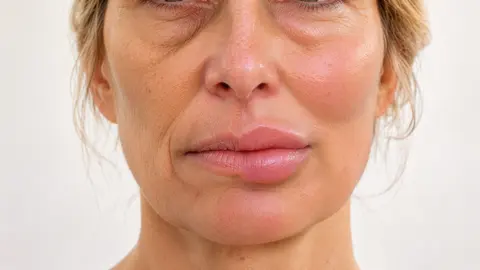
Almost everyone who sits in an injector's chair says the same thing first: "I don't want to look fake." And yet overtreated faces are everywhere. How does it happen, and what can you do if it's happened to you?
On this week's Facially Conscious episode, Have I Had Too Much Filler?, board-certified dermatologist Dr. Vicki Rapaport, esthetician Trina Reneá, and consumer advocate Julie Falls welcomed back Natalia Guzman, a board-certified nurse practitioner with more than 10 years in aesthetics and plastic surgery, a national trainer for injectors, and the founder of Atelier Aesthetix in Beverly Hills.
What does an overtreated face look like?
Natalia said you usually know it the moment you see it, and the most common cause is treating one area in isolation. A patient who has lost weight and volume across the face asks only for lips. The lips get fuller, but the chin and mid-face have no support. The result looks overdone, even though the patient was afraid of exactly that.
At the other extreme, some younger patients keep asking for more because they get used to the swelling, or to a tight, contoured look, and lose perspective.
Is it the product or the injector?
Natalia was direct: "The problem, majority of the times, is not the products. It is the injector." Some injectors keep selling because they need to make money. Some don't understand rheology, how each filler behaves, how firmly it holds its shape, and where it belongs. Either way, the patient trusts the injector, and that trust is a lot of power.
That's why she tells patients no when they don't need something, and why she says a good injector should. As she put it, when she says no, even though she needs to make money, she's protecting you.
She was also honest about her profession's past. When fewer products existed, injectors tried to lift nasolabial folds by adding more and more filler to the cheeks, something filler can't really do. Today, she said, the approach is about repositioning and restoring the right areas and softening transitions, not adding volume everywhere.
How long does filler actually last?
Dr. Vicki pointed out that filler companies used to tell injectors their hyaluronic acid fillers last about six months. She learned otherwise from her own patient, a man she'd treated for a couple of old acne scars. She told him to come back in six months. He came back three years later, and when she asked where else he'd had filler, he told her it was still her work. Filler often lasts much longer than people are told, which is one reason overtreatment adds up.
Can filler be dissolved?
Trina asked the question many of her clients are asking. She's seen clients look back at photos of themselves and barely recognize their own faces.
Natalia explained that hyaluronic acid filler can be dissolved with an enzyme called Hylenex. She scans the face with ultrasound first, so she can see the product, tell what kind of material it is, and target it directly. That means less enzyme and fewer potential complications.
She shared a patient who had lived for 15 years with filler injected into the muscle near her smile lines. The muscle had encapsulated it, so it was never going to break down. After a targeted dissolve, the patient said, "My smile is back."
What can't be dissolved?
Sculptra is a biostimulator. The product itself is metabolized and leaves the body, and what remains is your own collagen. You can't dissolve your own collagen, though Natalia said treatments like Morpheus 8 or Sylfirm can sometimes help reduce bulk. That's why Sculptra takes a skilled injector who knows how much to use and how many sessions a patient needs.
Radiesse: Natalia said it can't be dissolved the way hyaluronic acid filler can. She won't use it in the face or neck for that reason, and she's seen serious complications when it was placed in the nasolabial folds.
Permanent fillers are the biggest concern. "Permanent is not a good thing because we are not permanent," Natalia said. Faces change with age, and a permanent product doesn't change with them. She also doesn't like nose filler: layered over the years, it tends to spread and widen the nose, and the risk to the eyes isn't worth it in her view. Dr. Vicki agreed that so much of the overtreated face comes down to poor technique, poor placement, and poor product choice, which is why choosing a skilled, conservative injector matters most.
What does "natural" mean now?
Julie asked Natalia what natural means to her in 2026. Her answer: respecting your anatomy, and using more than one tool. Not just filler, but biostimulators, skin treatments, skincare, and facials. "Trina knows skin is paramount," she said. The first thing anyone notices is beautiful skin.
Trina added the most practical tip of the episode. Before you see an injector, bring a photo of yourself from 10 or 20 years ago. Your injector doesn't know what you looked like before your face started to fall. A photo shows them what to restore, so you still look like yourself.
Natalia agreed, and added the other half: injectors have to be realistic. If the only real fix is surgery, a good injector tells you, and sends you to talk to a plastic surgeon. She's seen injectors place 40 threads in one face. If someone needs that much, she said, they need a surgical consult, not more threads. She also advises stopping treatments about a year before a facelift, while Sculptra in the years before surgery can help the skin hold the result longer.
Why natural costs more than you think
Dr. Vicki shared a story about a patient who told her injector she had $500 to spend, and the injector said she couldn't do anything with that. A good injector doesn't want to treat one thing in isolation.
Trina said injectors should explain at the start that this isn't one-and-done. It's an ongoing investment in keeping your face. And her bottom line: "Don't go cheap. Not when it comes to your face. Never."
Natalia, who is 42, shared her own history of treatments to make the point that natural results are rarely the result of doing nothing. They come from a plan, with intention, over time.
And as Dr. Vicki said at the end: if you've been overtreated, there is help on the way.
Keep going
Listen to the full episode, Have I Had Too Much Filler?
Join the Facially Conscious Substack for extended content and deeper dives
Read Trina's personal take on the episode, as the esthetician in the room, on her Substack
Links

The Skin Master
Co-host | When Trina Renea became an esthetician she realized the key to success was lifelong learning - a goal that sets her apart from most skin care practitioners.
For over 30 years, she’s explored the fields of cosmetic chemistry, medical esthetics, dermatology, and plastic surgery, becoming an expert in a wide expanse of professional skin care brands, equipment, and treatments. She is a member of the Society of Cosmetic Chemists with three certifications in cosmetic sciences from UCLA and continues to attend spa, medical, esthetic, and scientific conferences worldwide.
Now considered a skin master due to her broad expertise, Trina is a consultant to the Southern California beauty industry and medical esthetic community, selecting and training staff, developing treatments, guiding product selection, and helping professionals best serve their clients.
In 2004, she founded the Facial Bungalow, a clinical spa offering advanced skin care technologies where she continues to work one-on-one with clients to this day. In 2008 she created Trina Renea Skincare.

Can Melasma Ever Really Go Away? Two Dermatologists and an Esthetician Explain