The Truth About Skin Hydration: Best Ingredients, Barrier Repair, and What Really Works
Why Your Skin Still Feels Dry—Even After Moisturizing
If you’ve ever layered multiple serums and moisturizers yet still experienced tight, uncomfortable skin, you’re not alone. One of the most common frustrations in skincare—both for professionals and everyday users—is understanding why hydration routines don’t always work as expected.
The issue is rarely about effort. More often, it comes down to misunderstanding how skin hydration actually functions.
In this episode of the Facially Conscious Podcast, our expert hosts explore the science of hydrating ingredients, the role of the skin barrier, and why certain widely accepted skincare beliefs may be misleading.
Dehydrated Skin vs. Dry Skin: A Critical Distinction
One of the most important—and often overlooked—concepts in skincare is the difference between dehydrated skin and dry skin.
Dehydrated Skin (Water Deficiency)
- Lacks water, not oil
- Can occur in any skin type (including oily skin)
- Feels tight, dull, or sensitive
- Fine lines may appear more noticeable
Dry Skin (Lipid Deficiency)
- Lacks oil (sebum)
- Is a skin type, not a temporary condition
- Often feels rough, flaky, and consistently tight
This distinction matters because hydrating ingredients and barrier-repair ingredients serve different roles. Misidentifying your skin’s needs can lead to routines that feel ineffective—or even counterproductive.
Does Drinking Water Hydrate Your Skin?
A widely repeated belief is that drinking more water will directly improve skin hydration. While hydration is essential for overall health, its impact on the skin is more indirect than many assume.
The body prioritizes vital organs first. By the time water reaches the skin, it has already been distributed elsewhere. This means that while severe dehydration can affect skin, topical hydration is the primary way to improve skin moisture levels.
The Skin Barrier: The Foundation of Hydration
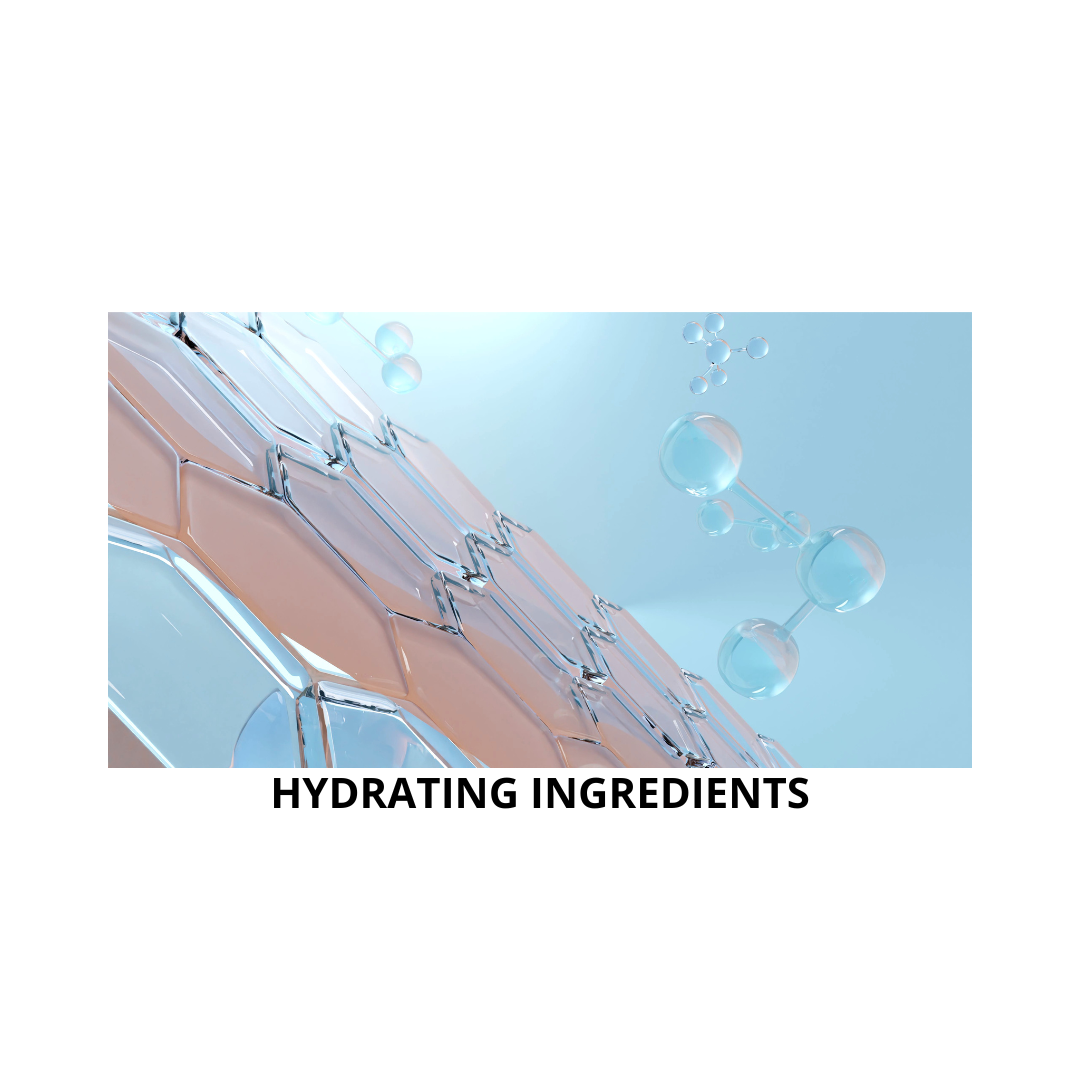
At the center of effective skincare is the skin barrier—a structure often described as a “brick and mortar” system:
- Skin cells (corneocytes) = bricks
- Lipids (ceramides, fatty acids, cholesterol) = mortar
When intact, the barrier:
- Prevents trans-epidermal water loss (TEWL)
- Protects against environmental stressors
- Maintains overall skin balance
When compromised:
- Water escapes more easily
- Skin becomes more reactive and dehydrated
Common Causes of Barrier Damage:
- Over-exfoliation
- Harsh cleansers
- Environmental stress
- Overuse of active ingredients
Before focusing on adding hydration, the barrier must be supported—otherwise, hydration cannot be retained.
Glycerin: One of the Most Effective Hydrating Ingredients
Among all hydrating ingredients, glycerin remains one of the most reliable and underappreciated.
Why Glycerin Works:
- Naturally present in the skin
- Well-tolerated across skin types
- Effective at low concentrations (2–5%)
- Provides immediate comfort
As a humectant, glycerin attracts water into the outer layers of the skin, helping improve softness and elasticity.
Despite its simplicity, glycerin is widely supported in both clinical and esthetic practice as a foundational hydrating ingredient.
Hyaluronic Acid: Effective, but Context Matters
Hyaluronic acid is often highlighted for its ability to bind water—up to 1,000 times its weight. However, its effectiveness depends heavily on how it is used.
Key Considerations:
- Works best when applied to damp skin
- Requires an occlusive layer to prevent water loss
- Can contribute to dehydration in dry environments if used alone
Without proper layering, hyaluronic acid may pull water from deeper skin layers, leading to increased dryness over time.
Oils and Hydration: Understanding Their Role
Oils are frequently described as “hydrating,” but their primary role is different.
What Oils Actually Do:
- Strengthen the lipid barrier
- Reduce water loss
- Improve skin resilience
They do not provide water to the skin directly. Instead, they support hydration indirectly by helping the skin retain moisture.
This distinction is especially important for individuals with dehydrated but oily skin, where excessive oil use may not address the underlying issue.
Occlusives and “Slugging”: Preventing Water Loss
Occlusives play a critical role in hydration by forming a seal over the skin.
Example: Petroleum Jelly (Slugging)
- Prevents trans-epidermal water loss
- Supports overnight barrier repair
- Non-comedogenic when used appropriately
A simple approach:
- Apply hydration to damp skin
- Seal with an occlusive layer
This method can be particularly beneficial for compromised or highly dehydrated skin.
Building an Effective Hydration Routine
Rather than focusing on individual products, hydration should be approached as a layered system.
For Dehydrated Skin:
- Gentle cleanser
- Hydrating toner or essence
- Humectant (glycerin or hyaluronic acid)
- Lightweight moisturizer
- Optional occlusive (as needed)
For Dry Skin:
- Cream-based cleanser
- Hydrating layers on damp skin
- Combination of humectants + lipids
- Rich moisturizer with ceramides
- Optional facial oils
Universal Principles:
- Apply products to damp skin when possible
- Avoid over-exfoliation
- Prioritize barrier repair
- Allow time (2–4 weeks) for visible improvement
Key Takeaways on Skin Hydration
- Hydration is about water, not oil
- The skin barrier determines how well hydration is retained
- Glycerin is one of the most effective and reliable humectants
- Hyaluronic acid requires proper layering to be effective
- Oils support hydration indirectly through barrier repair
- Simplicity and consistency often outperform complexity
Continue the Conversation
Hydration is one of the most discussed—and misunderstood—topics in skincare. This article highlights only part of a deeper, interdisciplinary conversation.
For a more comprehensive exploration of hydrating ingredients, clinical insights, and practical applications, listen to the full episode of the Facially Conscious Podcast.
Have a question? Send us an email at info@faciallyconscious.co
LIKE, FOLLOW & REVIEW US ON INSTAGRAM, & WHERE YOU LISTEN TO PODCASTS!
Visit our website www.faciallyconscious.com
Linktree | Facially Conscious
Join our new Patreon and Substack for more content from Facially Conscious
Follow Our Hosts On Instagram
Trina Renea - Medically-trained master esthetician and celebrities’ secret weapon
Linktree | Trina Renea, @trinareneaskincare, trinarenea.com and Substack
Julie Falls- Our educated consumer is here to represent you! @juliefdotcom
Dr. Vicki Rapaport -Board Certified dermatologist with practices in Beverly Hills and Culver City @rapaportdermatology and https://www.rapdermbh.com/

The Skin Master
Co-host | When Trina Renea became an esthetician she realized the key to success was lifelong learning - a goal that sets her apart from most skin care practitioners.
For over 30 years, she’s explored the fields of cosmetic chemistry, medical esthetics, dermatology, and plastic surgery, becoming an expert in a wide expanse of professional skin care brands, equipment, and treatments. She is a member of the Society of Cosmetic Chemists with three certifications in cosmetic sciences from UCLA and continues to attend spa, medical, esthetic, and scientific conferences worldwide.
Now considered a skin master due to her broad expertise, Trina is a consultant to the Southern California beauty industry and medical esthetic community, selecting and training staff, developing treatments, guiding product selection, and helping professionals best serve their clients.
In 2004, she founded the Facial Bungalow, a clinical spa offering advanced skin care technologies where she continues to work one-on-one with clients to this day. In 2008 she created Trina Renea Skincare.
What Happens to Your Face on GLP-1s? A Dermatologist and an Esthetician on "Ozempic Face"